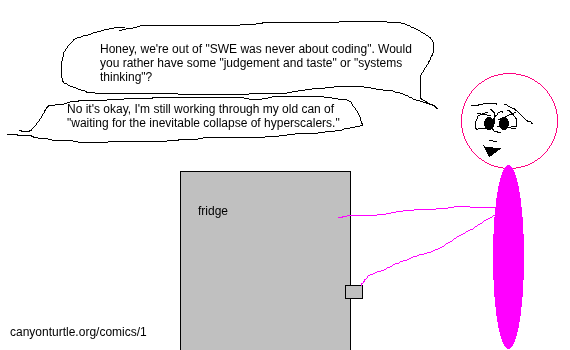
My unorganized thoughts, complaints, and perspectives about the inevitable march of the simulacrum
I went to college wanting to pick a career that would have longevity in the face of AI, so I majored in applied mathematics and minored in computer science. Good thing we'll need programmers to write the AI, right? And hey, if the AI writes the AI, at least AI can't prove the quasi Riemann Hypothesis, right? (Proceeds to prove the quasi Riemann Hypothesis)
It's not like I was going to prove the quasi Riemann Hypothesis, but now I can't even maintain a delusion about proving the quasi Riemann hypothesis anymore??
2026 is about being flexible
What does it mean to be a software engineer? What is intelligence? What is scarce and marketable about my career, when the central keystone that brought me here in the first place (I'm referring to coding, a practice in which you type source code into a file for compilation) is increasingly something I'm expected to orchestrate rather than to, you know, do?
We all need jobs. So we adapt as best we can. I want to give a lens in what that means for me in how I work. I believe that software engineering will increasingly be marketable on the basis that engineers can synthesize the exponential power of AI better than non-engineers by merit of engineers being able to... do something that lives somewhere in the following ideas.
Leveraging AI smoothly
If I believe anything about AI usage, it is this. AI's ability to help a software product is primarily a function of these parts:
- The clarity of the stated product needs.
- The robustness of the codebase to structurally adapt to the distributionally different shape of AI-authored code. Can a codebase's patterns scale logarithmically with the complexity of the needed features? Does it remain clear how to find any single feature? How to test it?
- The quality of the staging environment and otherwise nonprod resources available to engineers to allocate to AI agents to allow those agents to converge upon correct solutions.
Protecting simplicity
Simplicity is hard. It's probably the thing I think sets apart good code from bad code, when it boils down to it.
- Do I need to know about the 5 different lava flows that motivated the history of this codebase to be productive?
- Can I actually read and understand what a piece of code is doing?
- Is code littered with arbitrary complex decisions made at the behest of AI, such that the forest is lost in the trees?
What's interesting to me about simplicity is that the largest functional constraint (an engineer's time to code something) has been stretched exponentially. Should simplicity be a free variable allowed to just balloon in that space?
Some engineers will hand wave this by saying "the agent's testing framework and feedback loops are what guarantee quality, not the code itself anymore." And while I tend to agree these loops help with delivering something, it feels... myopic. In the end, I belive having a simple codebase will respond much better to changing needs than one that has to churn several thousand lines to make a small feature.
But hey, maybe that's just the pre-AI copium mindset that doesn't remember how easily a few thousand lines can be rewritten these days.
Organizational and Design clarity
I really like Conway's law and what it has to say about how engineering work gets shaped by organizational structures. When knowledge is silo'ed and disconnected, I believe it ripples into what gets implemented and maintained. For this reason, the importance of good collaborative design in the sense of technical design is something I think remains.
When you dive into writing a feature, who is solving the many edge cases and problems that come up? What decisions get made on behalf of finishing? Were those decisions well thought through? Were they understood by the team?
When teams prioritize shifting thought "to the left of the kanban board" -- that is, planning and discussing architecture, working through a shared design document, and pass review before writing code, I think something magical happens. It gives the team a chance to actually understand the product. To actually voice concerns and design patterns that should be followed. This is a type of teamwork that scalable engineering benefits immensely from.
Conclusion
Here be some thoughts. Take them with you. Make them yours. Let me know what you think.